
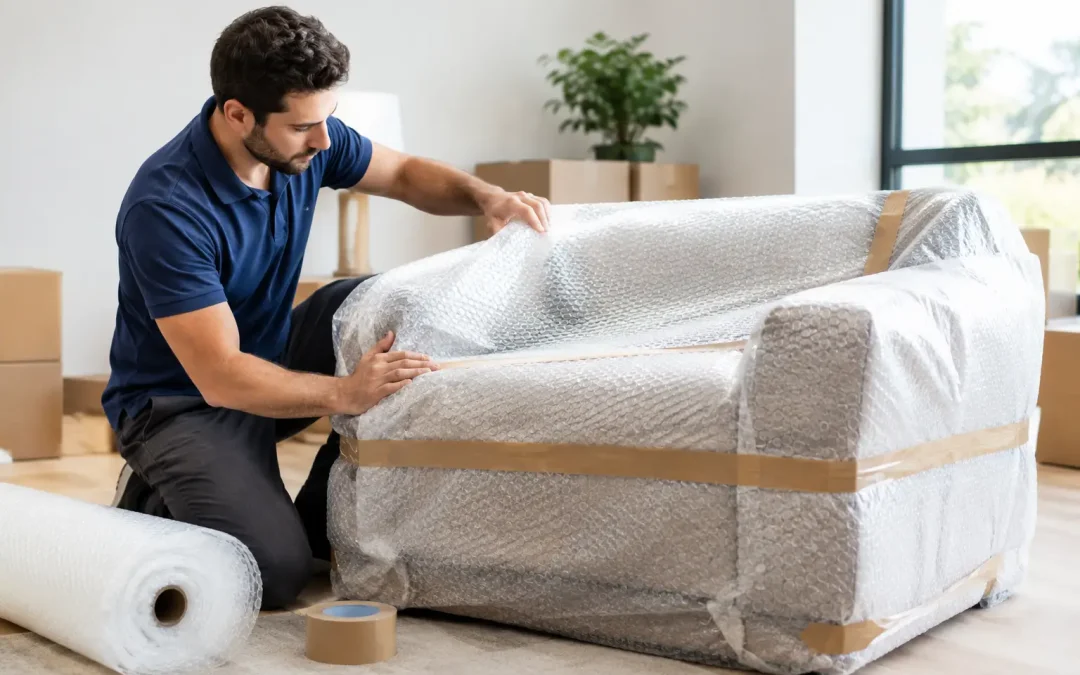
A dining table can look perfectly protected in a garage and still arrive with a snapped leg, crushed corner, or scratched finish. Large shipments fail most often at the points where they are lifted, stacked, turned, and transferred between vehicles. This guide to large item packing focuses on preparing for those real conditions, not simply wrapping an item until it looks covered.
Whether you are shipping furniture, artwork, electronics, equipment, trade-show materials, or an awkwardly shaped part, the goal is the same: keep the item stable inside the package, protect its vulnerable areas, and give the carrier a package that can be handled safely.
Start With the Item, Not the Box
Before choosing packing materials, inspect the item closely. Identify what can break, bend, scratch, loosen, or catch on another package. A solid wood cabinet may need corner protection and a rigid outer carton, while a large monitor needs careful screen protection and cushioning that keeps pressure away from the display.
Ask whether the item can be partially disassembled. Removing table legs, shelves, handles, wheels, or detachable components can reduce the package size and eliminate common break points. Keep hardware in a sealed, labeled bag, then secure that bag to an interior component or place it in a clearly marked accessory box. Do not allow loose screws or brackets to move around inside the shipment.
Disassembly is not always the right choice. Antique furniture, calibrated equipment, and certain assembled products can be damaged by unnecessary handling. If taking an item apart creates more risk than it removes, pack it in its assembled form with the right internal support.
Measure the Packed Shipment Accurately
A frequent mistake is measuring only the item. Carriers assess the finished package, including the box, foam, corner guards, pallet, and any protective overhang. An item that barely fits into a carton may be too large for the service level you planned once proper cushioning is added.
Measure length, width, and height at the package’s widest points after packing. Weigh the completed shipment, too. Large packages may be rated by dimensional weight rather than actual scale weight, and oversized limits can vary by carrier and service. A shipment that is technically shippable may still require a different service, special handling, or freight-style preparation.
This is where an in-person rate comparison can save time. With UPS, FedEx, USPS, and DHL options available in one place, a shipping professional can help identify which carrier can accept the package and which service fits the delivery timeline. The best choice depends on the package dimensions, destination, declared value, and how much handling risk the item can tolerate.
Build Protection in Layers
Large item packing works best when each layer has a job. Surface protection prevents scuffs and moisture exposure. Cushioning absorbs impact. A rigid outer package resists crushing and punctures. Skipping one layer often shifts too much responsibility to the others.
Start by covering finished surfaces with clean packing paper, foam sheets, furniture pads, or another nonabrasive material. Avoid placing bubble wrap directly against delicate painted, polished, or coated surfaces when heat or pressure could leave an impression. For glass, mirrors, screens, and framed artwork, use a protective surface layer before adding cushioning.
Then reinforce vulnerable points. Corners, edges, handles, legs, protruding controls, and thin panels need more than a single wrap of bubble cushioning. Use fitted foam, corrugated corner guards, edge protectors, or shaped inserts that spread pressure across a broader area. A corner is likely to take the first impact, so it deserves the strongest protection.
For heavy items, choose dense cushioning materials that will not flatten under the load. Lightweight loose fill can be useful for small voids, but it is rarely enough for a heavy or oversized shipment. If the item can settle to the bottom of the carton during transit, it needs stronger support beneath it.
Choose a Box That Can Do the Work
A used box may be fine for light household items, but it is a risky choice for a large, heavy, or valuable shipment. Cardboard loses strength when it is creased, damp, punctured, or previously compressed. A box that looks acceptable can fail at its seams once weight is added.
Choose a new, heavy-duty carton with enough room for cushioning on every side. As a practical starting point, allow several inches of protective material around the item, with additional support for fragile pieces. The exact space needed depends on the item’s weight and fragility. A large plastic storage bin is not automatically a shipping container, either. Its lid and walls may crack or separate under stacked weight.
When one carton is not enough, custom packaging may be the safer route. A double-wall carton, telescoping box, reinforced corrugated wrap, palletized shipment, or custom crate can provide the structure an oversized item needs. Crating is particularly helpful for unusually shaped, high-value, or highly fragile items that cannot safely be suspended within a standard box.
The trade-off is size and weight. More protection can increase shipping costs and limit carrier options, but underpacking a difficult item is usually the more expensive decision if it arrives damaged.
Keep the Item From Moving Inside
The most useful test is simple: once the package is sealed, gently shift it from side to side. You should not hear or feel the item slide, rattle, or strike the carton walls. External wrapping cannot compensate for movement inside the box.
Fill empty spaces with the correct material for the job. Use foam blocks, corrugated inserts, folded cardboard, air cushions, or dense bubble cushioning to hold the item in position. Keep cushioning balanced around the load so the item does not lean toward one side. For a heavy object, build a supportive base first, place the item on it, then secure the sides and top.
Do not use newspaper as the primary protection for a large or fragile item. It compresses quickly and provides limited shock absorption. It can still be useful as a clean surface wrap or to fill very small gaps, but it should not carry the main load.
Reinforce the Outside Before Sealing
Once the item is immobilized, close the carton with pressure-sensitive packing tape designed for shipping. Apply tape across the center seam and along both edge seams in an H pattern. Heavy cartons may need reinforced tape or strapping, but strapping should supplement a strong carton rather than rescue a weak one.
Remove or completely cover old labels, barcodes, and hazardous markings if you are reusing an outer carton. Conflicting labels can lead to routing errors. Place the shipping label on the largest flat surface, where it will not fold over an edge or seam.
If the contents are fragile, a fragile label can provide an extra visual cue, but it is not a substitute for proper packaging. Pack every box as though it may be stacked, tilted, and handled by someone who does not know what is inside. That is the standard that gives the shipment its best chance of arriving safely.
When a Pallet or Crate Makes More Sense
Some items have outgrown parcel packing. Very heavy equipment, large commercial components, bulky furniture, or shipments with irregular shapes may need to be secured to a pallet or enclosed in a crate. This helps prevent shifting and gives forklifts or pallet jacks a stable base for handling.
A pallet should be large enough that the item does not overhang the edges. Overhang leaves corners exposed and can make the load unstable. Secure the item with appropriate stretch wrap, banding, edge protection, and blocking. A crate should prevent internal movement without placing damaging pressure against delicate surfaces.
Not every large item requires a pallet. A boxed item that remains within carrier size and weight limits may travel more efficiently as a standard parcel. The right approach depends on the item’s construction, destination, urgency, and the services available for its final dimensions.
Give Yourself Time for a Professional Check
Large shipments are not ideal last-minute errands. Gathering the right materials, measuring accurately, and confirming carrier requirements takes time, especially when an item needs custom packaging. Bringing the item in before a pickup cutoff gives you more room to compare options and make adjustments if the first packing plan is not strong enough.
At Mr. Parcel of Dallas, large and fragile shipments can be evaluated with the item in front of us, rather than guessed at from a photo or a rough measurement. That personal review can reveal issues such as unsupported legs, weak cartons, dimensional limits, or a better carrier choice before the package is already on its way.
A well-packed large item should feel uneventful when it leaves your hands. No shifting, no exposed edges, no uncertain measurements – just a package built to handle the trip ahead.